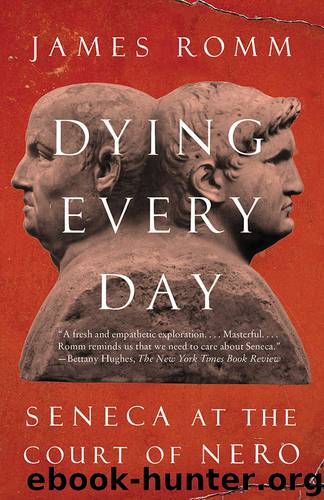
Dying Every Day: Seneca at the Court of Nero by James Romm
Author:James Romm [Romm, James]
Language: eng
Format: azw3
ISBN: 9780385351720
Publisher: Knopf Doubleday Publishing Group
Published: 2014-03-10T16:00:00+00:00
Unable to resign even at the price of his huge estate, Seneca had nonetheless withdrawn from court to the degree that was safe. He no longer kept up the routine of a powerful statesman, no longer saw crowds of clientelae, friends in need of favors, in his chambers each morning. He rarely went out in public, and when he did, he no longer had a large retinue of attendants. He was trying, within the limits Nero had set, to reduce his visibility.
His pace of writing increased. He had more time now for moral reflections and a greater need to publish them, for his reputation had suffered badly as Nero had spiraled downward. From 62 on, he produced an astounding body of work, some of it now lost, much still extant. His longest and most ambitious prose works were composed at this time and, almost certainly, his most harrowing tragedy, Thyestes. Seneca, now at the peak of his literary powers, was writing like a man running out of time—as indeed he was.
Seneca was in his midsixties and feeling his age. Constantly cold, depleted by lifelong respiratory disease, he claimed to be “among the decrepit and those brushing up against the end.” Everywhere he looked, he saw reminders that he had passed into the last phase of life, his senectus. Making the rounds of his estates, he found that a stand of plane trees had become gnarled and withered; he scolded a caretaker for failing to irrigate them. The man protested that the trees were simply too old to be helped. Seneca did not reveal to the caretaker, but did to his readers, that he himself, in youth, had planted those trees.
Seneca was often on the move, whether checking on his properties or following the emperor and the court through Italy. He was in Campania much of the time, sometimes visiting the wealthy resort towns of Baiae and Puteoli. He went at least once to Pompeii, as he eagerly wrote to his old friend Lucilius, a native of that town. Seneca felt closer to Lucilius as the years advanced, perhaps because so many other friends were dead. A man slightly younger than Seneca, a fellow member of Nero’s staff—caretaker of the emperor’s estates in Sicily—Lucilius shared Seneca’s literary tastes and philosophic concerns. He was also a fellow survivor, having undergone torture at the hands of Messalina and Narcissus, Seneca’s persecutors as well.
Wherever Seneca went in these years, he carried on work on his magnum opus, a remarkable set of short moral essays framed as letters. Ostensibly addressed to Lucilius, these letters were in fact aimed at a wide audience. But the fiction of an intimate correspondence gave Seneca latitude in the structure of the essays, as well as unusual freedom to vary voice, tone, and technique. The melding of ethical inquiry with epistolary style produced a breakthrough for Seneca. He carried on the Letters to Lucilius at far greater length than anything else he had written and with greater candor about his life and thoughts—or at least, what seems to be candor.
Download
This site does not store any files on its server. We only index and link to content provided by other sites. Please contact the content providers to delete copyright contents if any and email us, we'll remove relevant links or contents immediately.
| Africa | Americas |
| Arctic & Antarctica | Asia |
| Australia & Oceania | Europe |
| Middle East | Russia |
| United States | World |
| Ancient Civilizations | Military |
| Historical Study & Educational Resources |
The Daily Stoic by Holiday Ryan & Hanselman Stephen(3306)
The Fate of Rome: Climate, Disease, and the End of an Empire (The Princeton History of the Ancient World) by Kyle Harper(3062)
People of the Earth: An Introduction to World Prehistory by Dr. Brian Fagan & Nadia Durrani(2734)
Ancient Worlds by Michael Scott(2682)
Babylon's Ark by Lawrence Anthony(2674)
The Daily Stoic by Ryan Holiday & Stephen Hanselman(2573)
Foreign Devils on the Silk Road: The Search for the Lost Treasures of Central Asia by Peter Hopkirk(2463)
India's Ancient Past by R.S. Sharma(2451)
MOSES THE EGYPTIAN by Jan Assmann(2412)
The Complete Dead Sea Scrolls in English (7th Edition) (Penguin Classics) by Geza Vermes(2277)
The Earth Chronicles Handbook by Zecharia Sitchin(2227)
Lost Technologies of Ancient Egypt by Christopher Dunn(2224)
24 Hours in Ancient Rome by Philip Matyszak(2079)
Alexander the Great by Philip Freeman(2065)
Aztec by Gary Jennings(2023)
The Nine Waves of Creation by Carl Johan Calleman(1916)
Curse Tablets and Binding Spells from the Ancient World by Gager John G.;(1860)
Before Atlantis by Frank Joseph(1849)
Earthmare: The Lost Book of Wars by Cergat(1825)
